Start here — what do you need?
- I've never tried natto — will I like it? → taste and smell section below
- I want to learn how to eat natto properly → how-to-eat section below
- I want to understand what natto is → fermentation and origin section below
- I'm interested in natto's health benefits → nutrition section below
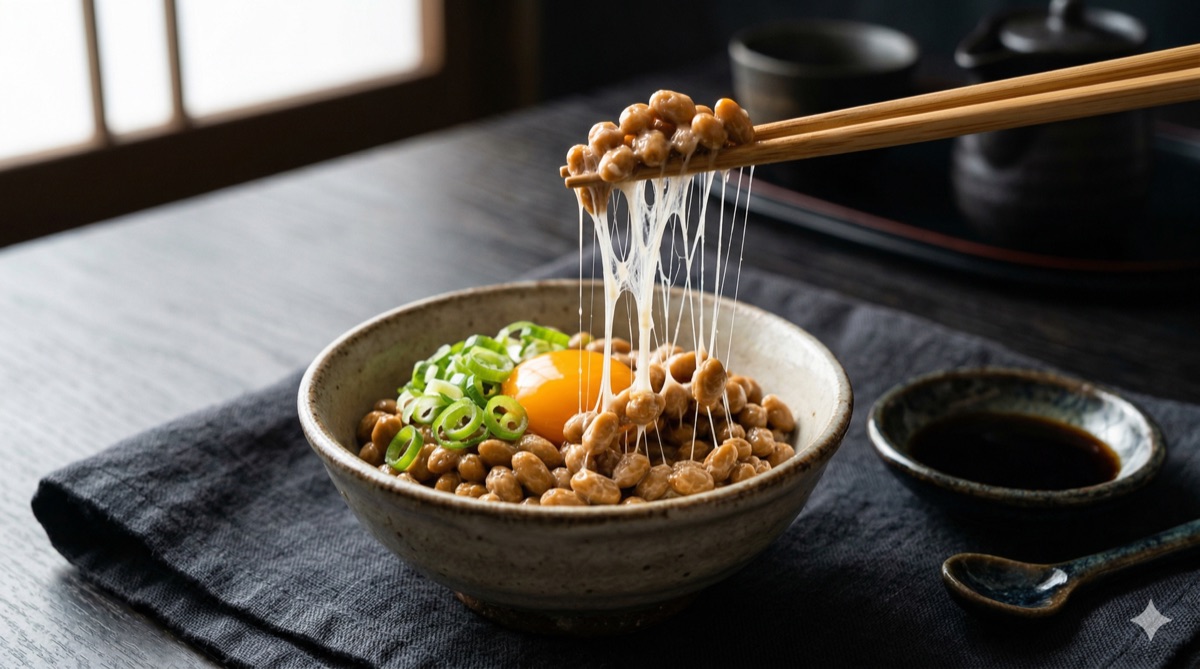
What Natto Actually Is
Natto is whole soybeans fermented with Bacillus subtilis var. natto bacteria at 40–43°C for 18–24 hours, producing a sticky, stretchy, strongly aromatic Japanese food with earthy-nutty flavour and the highest vitamin K2 concentration of any natural food (870 mcg per 100 g). During fermentation, the bacteria produce polyglutamic acid — the compound responsible for natto's signature sticky strings — along with volatile compounds (ammonia and fermented soy esters) that create the strong aroma.
The result is whole beans with an intact bite, covered in a sticky white film of polyglutamic acid peptides, carrying an earthy, ammonia-forward smell and a taste that is nutty, umami-rich, and slightly bitter.
Natto is believed to have originated in the Ibaraki and Kanto regions of Japan, where the traditional preparation involved wrapping cooked soybeans in rice straw — which naturally harbours B. subtilis. Modern production uses cultured starter bacteria for consistency, but the fermentation biology is identical. Natto is now consumed throughout Japan, most commonly at breakfast over hot rice.
The fermentation organism distinguishes natto completely from miso (which uses Aspergillus oryzae koji mold) and from other Japanese fermented foods. All three are soybean-based, but the organisms, textures, flavours, and uses share almost nothing in common.
What Natto Tastes and Smells Like (Honest)
The smell is the real barrier. Natto smells of ammonia and fermented soy — a profile similar to a strong soft cheese like brie or camembert, but more concentrated. For first-timers, this is the single biggest challenge, and it is legitimate: the smell is intense.
The taste is genuinely different from the smell. Once past the aroma, natto is earthy, nutty, and deeply umami-rich, with a slight bitter finish. The flavour is much milder than the smell implies — most people who expect the taste to match the aroma are surprised by how approachable it actually is.
The texture is sticky and stringy: polyglutamic acid peptides form elastic strings that stretch between the beans and the chopsticks. Stirring before eating develops these strings (40–50 stirs is standard). This texture is polarising separately from the smell.
The adaptation curve is real: people who grew up eating natto generally do not perceive the smell as unpleasant. Research on olfactory adaptation suggests 3–5 exposures is the threshold for most first-timers to stop registering the ammonia note as intrusive. Starting with hikiwari (crushed bean) natto — milder flavour, less stringy — is the standard recommendation for beginners.
How to Eat Natto Properly
The technique is not optional — it directly affects the flavour. Stirring before adding condiments develops the polyglutamic acid strings and amplifies umami through a poorly understood but well-documented mechanism. The standard in Japan is 40–50 stirs; the beans go from loosely coated to richly strung together.
- Stir 40–50 times before adding anything. Use chopsticks and stir vigorously in circles. The strings develop and the colour of the coating turns from white to creamy beige. Do this step cold, directly from the package.
- Add the included tare and karashi. Natto packs typically include a small packet of tare (a sweetened soy-based sauce) and karashi (hot Japanese mustard). Both are integral — the tare rounds out the umami and adds sweetness; the karashi cuts the richness and helps mask the aroma on first encounters.
- Serve over hot rice immediately. The heat from the rice gently warms the natto and slightly softens the strings. This is the default natto-gohan preparation — see the full natto gohan recipe for rice ratios and timing.
Optional additions that work well: chopped spring onion (negi), raw egg yolk stirred in before serving, finely sliced pickled ginger, kimchi. Raw egg yolk is particularly effective — it coats the beans and softens both the aroma and texture for beginners.
Temperature note: natto is served straight from the fridge over hot rice. Do not warm the natto separately — heat above 70°C destroys nattokinase and breaks down the strings.
Types of Natto
Four varieties are worth knowing. The differences are meaningful for both flavour and cooking applications:
Itohiki Natto (糸引き納豆) — Standard Whole Bean
The default: whole soybeans with maximum strings. The strongest flavour and most pronounced texture of all natto types. This is what most people mean when they say “natto.” If you are new to natto, this is not the easiest starting point — see hikiwari below.
Hikiwari Natto (挽き割り) — Hulled and Crushed
The outer hull is removed and the beans are crushed before fermentation. The result is milder in flavour, less stringy, and easier to integrate into dishes. This is the recommended starting variety for first-timers. It also performs better in cooking applications — natto pasta, natto toast — where the texture needs to blend rather than dominate.
Kotsubu Natto (小粒) — Small Bean
Made from smaller soybean varieties. The flavour is slightly sweeter and more delicate than standard itohiki natto; the beans are more uniform and the texture is slightly less sticky. Popular in the Kanto region and commonly stocked at Japanese grocery stores outside Japan.
Okara Natto — Soy Pulp
A rare variety made from okara (the soy pulp byproduct of tofu and soy milk production). Much milder in both aroma and flavour. Found at specialty Japanese stores and sometimes at health food stores. If you want to introduce someone to natto with the least confrontational option, okara natto is the choice.
Natto Nutrition: the Case for Eating It
Natto's nutritional profile is unusually strong even by fermented food standards:
Key nutrients per 100 g natto
Calories
Protein
Vitamin K2
Iron
Calcium
Nattokinase activity
One standard pack is 50 g (roughly half the values above). Serving size: 100 g is about 2 packs.
- Vitamin K2 (MK-7): 870mcg per 100g — the highest concentration in any natural food source. K2 MK-7 is the bioavailable form associated with bone health (activates osteocalcin) and cardiovascular health (prevents arterial calcification). Most Western diets are very low in K2; natto is the most efficient dietary source by a wide margin.
- Nattokinase: an enzyme unique to natto, produced by B. subtilis during fermentation, studied for fibrinolytic properties (breaking down fibrin in blood clots). Degrades above 70°C — do not cook natto if nattokinase is your reason for eating it.
- Probiotics: live Bacillus subtilis cultures. Unlike the lactobacillus in yogurt, B. subtilis is a spore-forming bacterium that survives stomach acid well and reaches the intestine alive.
Important caution: natto's very high vitamin K content creates a significant interaction with warfarin (Coumadin) and other vitamin K antagonist anticoagulants. If you take blood thinners, consult your doctor before consuming natto regularly — even small amounts can shift INR levels unpredictably.
Natto Beyond Rice: Cooking Applications
Natto is more versatile than its primary use over rice suggests. The guiding rule: use it raw or barely warmed (under 70°C) to preserve both nattokinase and the sticky texture.
- Natto gohan — the default preparation. See the natto gohan recipe for the full method with rice ratios and optional additions.
- Natto maki — sushi roll. Hikiwari natto works best: less stringy, blends with the rice more evenly. A classic in Japan, surprisingly uncommon at Western sushi restaurants.
- Natto pasta — with butter, soy sauce, and spring onion. Stir natto in off the heat after the pasta is plated. The butter coats the beans and softens the flavour; the soy sauce echoes the tare. An Italian-Japanese crossover that genuinely works.
- Natto toast — with avocado and a few drops of soy sauce. Common modern Japanese breakfast, particularly in younger urban households. Use hikiwari for easier spreading.
- In onigiri — natto as a rice ball filling. The strings hold together inside the rice well; wrap tightly in nori.
Do not use natto in: anything heated above 70°C — stir-fries, soups, baked dishes. The texture breaks down unpleasantly and the nattokinase benefit is lost.
Where to Buy Natto Outside Japan
Natto is almost always sold frozen outside Japan. The quality is excellent — freezing does not degrade the flavour significantly, and the product is essentially always available this way.
- Japanese and Korean grocery stores — Marukai, Mitsuwa, H Mart. Frozen section. The most reliable source; usually stocks multiple varieties including hikiwari and kotsubu.
- Online (frozen shipping): Search frozen natto on Amazon — look for Mitsubishi (Mito brand) or Meiji. Frozen shipping availability varies by region; check seller shipping restrictions.
- Shelf life: frozen natto keeps 3 months. After thawing in the refrigerator overnight, use within 1 week. Do not refreeze after thawing — the texture degrades.
- Reading the pack: each pack contains 3 individual portions (50g each). The small packets inside are tare (sauce) and karashi (mustard). Both are meant to be used.
How to Make Natto at Home
Home natto requires only soybeans, a natto starter culture (Bacillus subtilis spores, available online for $5–10 — see where to buy natto starter for sources and a bootstrap method using store-bought natto), and a way to hold 40–43°C for 22–24 hours. The basic process: soak soybeans overnight, pressure-cook or steam until soft (about 45 minutes), mix in the starter culture while the beans are still warm, then ferment in a covered container at 40–43°C. An oven with just the light on, a yogurt maker, or an Instant Pot on yogurt mode can hold the temperature.
The strings develop during the first 12 hours; flavor deepens between 18–24 hours. After fermentation, refrigerate immediately to stop the process. Homemade natto keeps 5–7 days refrigerated. The smell during fermentation is strong — ventilate the area. For a detailed step-by-step with troubleshooting, see a dedicated natto fermentation guide.
Natto vs Other Fermented Soybean Foods
All three share soybeans as a base but are completely different products:
| Natto | Miso | Tempeh | |
|---|---|---|---|
| Organism | Bacillus subtilis bacteria | Aspergillus oryzae (koji mold) | Rhizopus oligosporus mold |
| Fermentation | 18–24 hrs, 40–43°C | Weeks to years | 24–48 hrs, 30°C |
| Texture | Whole beans, sticky strings | Smooth paste | Firm cake, dense |
| Flavour | Earthy, nutty, ammonia-forward | Umami, salty, complex | Nutty, mushroom-like, mild |
| Primary use | Over rice, direct eating | Seasoning, soup base | Protein substitute, cooking |
| Origin | Japan (Ibaraki/Kanto) | Japan (nationwide) | Indonesia (Java) |
For a deeper look at miso, see What Is Miso. For the fermentation biology behind both, see What Is Koji and the fermentation hub.
Frequently Asked Questions
- What is natto?
- Natto is whole soybeans fermented with Bacillus subtilis var. natto, a bacterium that produces sticky polyglutamic acid strings and a strong ammonia-forward aroma during an 18–24 hour fermentation at 40–43°C. The result is a strongly flavoured Japanese food with earthy, nutty, umami-rich taste, eaten primarily over rice. It originated in the Ibaraki/Kanto region and is now consumed throughout Japan, particularly at breakfast. The sticky strings are the defining physical characteristic — the more you stir, the stronger and more developed they become.
- What does natto taste like?
- Once you get past the smell, natto tastes earthy, nutty, and umami-rich with a slight bitterness — much milder than the aroma suggests. The texture is sticky and stringy (polyglutamic acid peptides). The included tare (soy-based sauce) and karashi (hot mustard) round out the flavour. Stirring 40–50 times before adding condiments develops the strings and amplifies umami — this is the correct technique, not a myth. People who grew up eating natto often do not notice the smell; first-timers typically need 3–5 exposures to adapt.
- Is natto healthy?
- Natto is exceptionally nutrient-dense. Per 100g: 18g protein, 870mcg of vitamin K2 (MK-7) — the highest concentration in any natural food source — live Bacillus subtilis probiotics, and nattokinase, an enzyme studied for fibrinolytic (blood-clot dissolving) properties. Nattokinase degrades above 70°C, so do not cook natto. The most important caution: natto is very high in vitamin K, which has significant interaction with warfarin and other blood thinners — consult a doctor before regular consumption if you take anticoagulants.
- How do you eat natto?
- Step 1: stir 40–50 times BEFORE adding condiments — this develops the polyglutamic acid strings and amplifies umami. Step 2: add the included tare (soy-based sauce) and karashi (hot mustard). Step 3: serve over hot rice; the heat slightly softens the strings. Optional additions: chopped spring onion (negi), raw egg yolk, pickled ginger, kimchi. The contrast of cold natto from the fridge over hot rice is intentional — do not warm the natto separately.
- Why does natto smell so bad?
- The smell comes from ammonia and other volatile compounds produced by Bacillus subtilis during fermentation — a profile similar to a strong soft cheese like brie or camembert, but more pronounced. The smell is the single biggest barrier for first-timers. Importantly, the taste is far milder than the aroma: most people who persist through 3–5 exposures find the smell recedes and the flavour becomes enjoyable. Eating natto over hot rice or with strong condiments (karashi, spring onion) helps mask the aroma on first encounters.
- Can you cook natto?
- You can add natto to cooked dishes, but heat above 70°C destroys nattokinase — the primary health-relevant enzyme. The sticky strings also break down with heat, and the flavour becomes more muted. Natto works best raw or barely warmed: over hot rice (the rice heats it gently), in natto maki (sushi rolls), on toast with avocado, or in natto pasta stirred in off the heat. Avoid applications where it will be actively cooked — the health benefits and texture are both better preserved cold.
- Where can I buy natto outside Japan?
- Frozen natto is available at Japanese and Korean grocery stores (Marukai, Mitsuwa, H Mart) year-round. Online, Amazon carries limited brands with frozen shipping — look for Mitsubishi (Mito brand) or Meiji. Fresh natto has a 1-week refrigerated shelf life; frozen keeps for 3 months — do not refreeze after thawing. Hikiwari (crushed bean) and kotsubu (small bean) varieties are usually the most widely stocked outside Japan; itohiki (standard whole bean) may require a larger Japanese grocer.
- What is the difference between natto and miso?
- Both are fermented soybean products, but they are completely different in organism, texture, and use. Natto is fermented by Bacillus subtilis bacteria at 40–43°C for 18–24 hours — the beans remain whole, sticky, and strongly aromatic. Miso is fermented by Aspergillus oryzae (koji mold) over weeks to years — the result is a smooth, umami-rich paste used as a seasoning. Natto is eaten as a food on its own (primarily over rice); miso is used as a condiment or soup base. Tempeh is a third soybean ferment — using Rhizopus oligosporus mold — with a firm, neutral flavour closer to meat than either natto or miso.
Where to Go Next
- Natto Gohan Recipe — the definitive natto over rice method, with rice ratios and optional additions
- What Is Miso — the other major fermented soybean product; completely different organism, texture, and use
- What Is Koji — fermentation context: the mold behind miso, sake, and soy sauce
- What Is Shio Koji — a related fermented ingredient used as a salt substitute and marinade
- Fermentation Hub — all Japanese fermentation guides, from miso to amazake to nukadoko
- Japanese Pantry — how natto fits into the broader Japanese ingredient system
- Onigiri — natto as a rice ball filling; technique and folding guide
- Guides Hub — all ingredient and technique guides
- PubMed — Nattokinase Research — clinical research on nattokinase and fibrinolytic activity
- Schurgers et al. (2000) — Vitamin K2 in fermented foods — menaquinone-7 content comparison across fermented foods
- USDA FoodData Central — Natto — full nutritional profile for natto
- How to Make Natto at Home — soybeans, starter, and the 24-hour incubation
This page contains affiliate links. If you purchase through these links, we may earn a small commission at no extra cost to you. Last updated: March 2026.